
Camas Directory Collections by Year
The Washington State Library catalog explicitly files Camas “In Vancouver directory.” That phrase is the key to the historical shelf. The surviving runs are intermittent, and no source promises that every Camas household appears in each edition.
| Collection | Years represented | Where held | Access |
|---|---|---|---|
| R.L. Polk Vancouver-area directories | 1907-09, 1911-16, 1918-19, 1921, 1928-29, 1931, 1934, 1938, 1940, 1950, 1952, 1954-55, 1957-60, 1962-63, 1965, 1967-74, 1982 | Washington State Library | Onsite volumes; ask local libraries about a holding copy |
| Clark County directories | 1918-19, 1921, 1928-29, 1931, 1934 | Washington State Library county collection | Onsite |
| Camas telephone books | 1929 through 2013-14, intermittent | Washington State Library | Onsite catalog collection |
| Camas and La Camas Sanborn maps | 1888, 1892, 1903, 1909, 1922, 1943 reported | Library of Congress and map collections | Free public images where available |
| Virginia Warren Collection | Three scrapbooks, donated 2019 | Camas Public Library | Digitized online |
| Camas Clerk minutes | 1973-present | Washington Digital Archives | Open keyword and year search |
The county bibliography identifies missing years within the 1918/19 to 1934 span, including 1920, 1922-27, 1930 and 1932-33. Treat the gaps as gaps. Move to the nearest telephone book, census, newspaper or deed rather than assuming the person left Camas.
Find Camas Inside Vancouver Volumes
A catalog search limited to a title beginning with “Camas” can miss the main city directory run. Search the Washington State Library city and telephone directory catalog for Vancouver, Clark County and Camas. Within the volume, test the locality heading, the surname index and the street guide. Older material may use “La Camas.”
The regional label reflects how the publisher grouped nearby communities, not a move to Vancouver. Camas, Washougal and other Clark County towns can share a book. Record the title page, publication year and exact section heading before copying an entry, since those details explain why the name appears under a broader place.
The State Library directory page captured for this project displays the catalog route and its Camas-in-Vancouver finding.
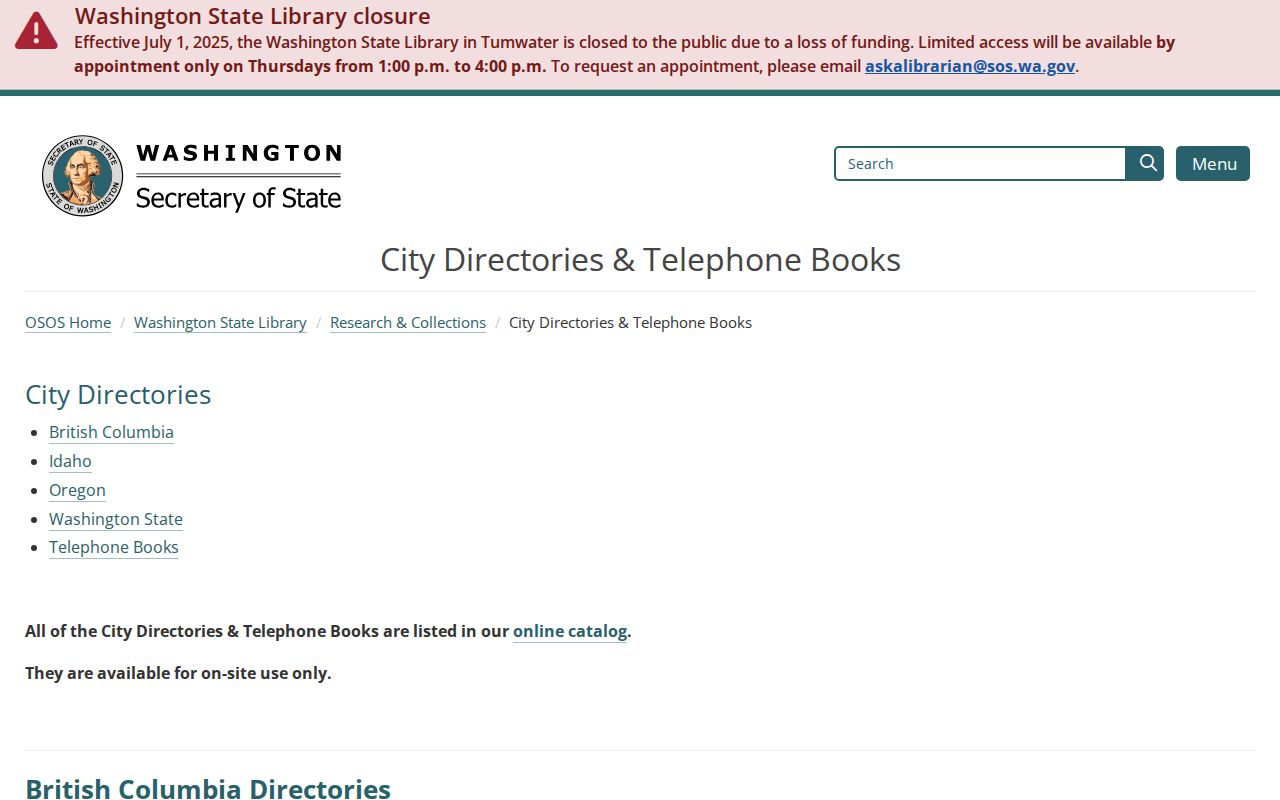
That catalog wording is the practical shelf key for a Camas city directory search.
Gaps in Camas Polk Directories
The Polk sequence is long but not annual in the surviving State Library list. Dense groups appear in the 1910s and again from the late 1950s into the 1970s, while other periods have only isolated years. A volume's absence from the catalog is not proof that no edition existed, and a resident's absence from a held edition is not proof of a move.
Choose the closest year on each side of the event being studied. If a person appears at one Camas address in 1967 and another in 1969, the move occurred sometime within that interval unless a deed, newspaper notice or permit narrows it. Preserve initials and spelling exactly. Married or former surnames, publisher abbreviations and a Vancouver heading can all split the same household across indexes.
Camas Telephone Books Bridge Years
Telephone holdings supply many dates not represented by the city directory list. Cataloged Camas runs include 1929; 1944; 1947-49; 1951-53; 1955; 1960-69; 1971-73; 1975-78; 1980; 1983-87; 1990-97; 1999-2001; 2006; 2008-09; 2011-12; and 2013-14. The State Library describes these as onsite materials.
A telephone book can tie a listed subscriber to an address and show continuity between fuller publication years. It is not a population register. Unlisted numbers, mobile-only households, shared lines and business listings create omissions or misleading matches. Compare a telephone entry to another dated source before treating it as household evidence.
Decode a Camas City Directory Entry
No inspected public page exposed a full Camas entry, so the following is a format inventory to verify against the actual volume, not a transcription of a named resident. Polk-style entries commonly combine compact facts that must be expanded only with the edition's own key.
| Printed name | Surname and given name or initials; a spouse may appear in parentheses |
|---|---|
| Work notation | Occupation and sometimes an abbreviated employer |
| Place | House number, street and sometimes a residence or boarding mark |
| Telephone | Number in later editions, which may be a home or business listing |
| Status marks | Some editions note an owner, renter or widow, subject to the printed legend |
Copy the whole line and photograph the key. Do not guess what “r,” “h,” “wid” or an employer's initials mean across editions.
- Criss-cross directory
- A section ordered by street and house number, useful when the address is known first.
- Householder index
- An alphabetical list centered on the named person or household listing.
- Abbreviation key
- The publisher's legend for shortened occupations, places and status marks.
Reverse Camas Directory Street Pages
The street-and-avenue guide turns the usual search around. Begin with the printed road and house number, then read the listed names above and below it. This can locate adjacent subscribers and catch a surname that was hard to read in the alphabetical section. It is especially useful when a family name changed but the home stayed the same.
Old addresses require restraint. No official source established a citywide Camas renumbering date. Search exact forms under La Camas, Camas and Vancouver headings, then use a Sanborn block, recorded plat or deed legal description to bridge the old number to the current parcel. The modern address workflow belongs to the Camas street directory; printed pages remain evidence for their edition year only.
Trace Families Through Camas Directories
A city directory fills the years between federal census schedules. It gives street continuity and a compact listing; a census can add household composition and enumeration context. Public federal schedules currently extend through 1950 under the 72-year release rule. Later census schedules remain closed until their release date.
- Choose the nearest held edition and search the surname, initials, address and Camas or La Camas heading.
- Transcribe the complete entry, then check its street guide for the same address and nearby listings.
- Move one edition forward and one back, noting every change in name form, occupation, phone or street.
- Compare the closest public census and map the building with a Sanborn sheet or plat.
- Test the address against deeds, newspapers, cemetery records, probate or later public minutes.
If a name disappears, search the next available directory, obituary and cemetery index before drawing a conclusion. A move, death, changed surname, missed canvass or unlisted phone can look the same in one volume.
Camas Library Adds Local Context
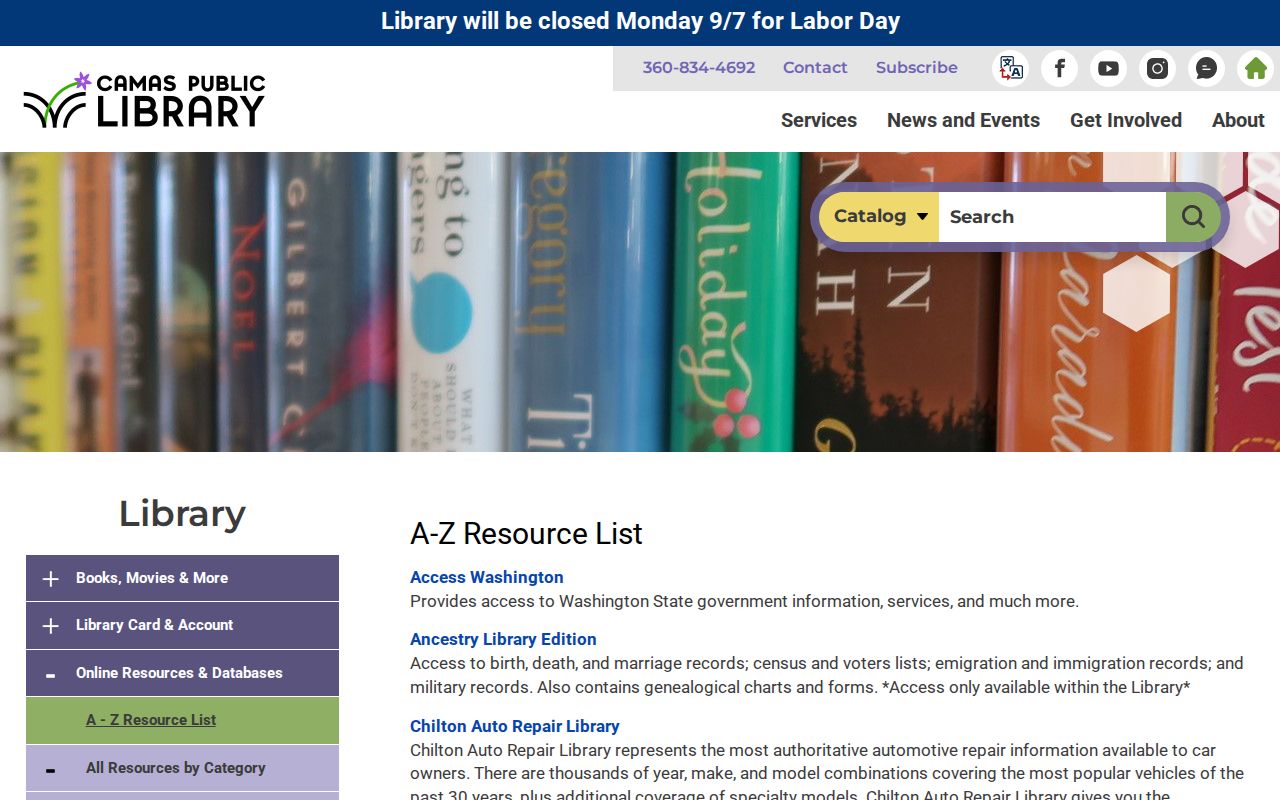
Camas Public Library, 625 NE 4th Avenue, provides Ancestry Library Edition for in-library use. Its A-Z list also includes Washington State Digital Archives, Washington genealogy links and NewsBank sources. The Camas-Washougal Post-Record is searchable from 2010 forward, The Columbian from 1994 and The Oregonian collection from 1987.
The Camas Library resource list is the starting point for those licensed and open databases.
Newspapers can explain a directory change through an obituary, marriage notice, school event, civic item or mill story.
The Virginia Warren Collection adds three digitized scrapbooks donated in 2019. Their clippings, information and photographs preserve Camas-area people and events that do not form a formal name index. Search the image or caption as context, then cite the original item where possible.
Camas Research Beyond the Catalog
Clark County Genealogical Society operates a public research library at 3205 NE 52nd Street in Vancouver. Its 10,000-plus items include Pacific Northwest books, surname files, maps, periodicals, microfilm, census and newspaper sources, local burial and vital-record aids. It is also a FamilySearch Affiliate Library. Selected CCGS compilations index Camas-Washougal Post-Record and East County vital notices for 2002, 2007-09 and portions of 1989-97.
Clark County Historical Museum offers paid research on a past resident, property or local event. Confirm scope and price before sending a broad request. Two Rivers Heritage Museum holds thousands of photographs and local artifacts. The historical society formed in 1978 during an effort to save the Van Vleet home; the house burned three days later, a sharp example of why community archives matter when a building is lost.
Camas Directory History in Context
The city’s population and institutions changed much faster than the surviving shelf. Camas grew from its paper-mill origin into a Columbia River city with historic downtown, Prune Hill, Grass Valley, Lacamas Lake, and newer subdivisions. A directory may therefore group one era around mill occupations and another around a wider Portland-Vancouver region. Treat each edition as a dated sample of listed households, not as a count of everyone inside the city line.
The city changed names, grew around the paper mill and adopted several kinds of records at different times. A short timeline helps select the right catalog term and source.
| Year or span | Camas research milestone |
|---|---|
| 1883 | LaCamas Colony laid out the mill town. |
| 1888 | The first known Sanborn sheet used the La Camas name. |
| 1907 | The town adopted Camas, and the listed city-directory run begins. |
| 1923 | The local library began with 150 State Library books in Thayer's Drugstore. |
| 1973-present | Digital Archives indexes Camas Clerk minutes; the title contains 2,014 records. |
| 2019 | Three Virginia Warren scrapbooks were donated for local digitization. |
The records do not form one continuous archive. Maps, directory volumes, telephone books, news files and minutes overlap, allowing a careful search to test the same person or place from more than one angle.