
Camas Previous-Resident Sources
A Camas address has several timelines. The Property Information Center, or PIC, establishes the current parcel, situs address, tax account, abbreviated legal description, and recorded-document links. “Situs” means the physical site, which can differ from the owner's mailing address. Landmark supplies the modern deed index. Printed directories and telephone books can reveal listed occupants. Census schedules supply household detail at decennial points, while maps and permits explain how the site changed. The source dates overlap, but none covers the whole story alone.
| Source | Years It Covers | Where Held | What It Shows |
|---|---|---|---|
| Landmark recorded documents | 1961 to present online | Clark County Auditor | Indexed parties, deed dates, filing numbers, and document images |
| Historic deed index and books | Index 1850-1977; deeds 1859-1921 | FamilySearch and archives | Older owners, book/page references, and legal descriptions |
| City and telephone directories | Intermittent 1907-2014 | State Library and local research rooms | Listed people, addresses, spouses, occupations, and phones |
| Federal census schedules | Public through 1950 | Library genealogy databases | Household members, ages, occupations, and tenure at census time |
| Maps, permits, and newspapers | 1888 onward, with gaps | LOC, City records, Library, CCGS | Building form, work dates, applicants, notices, and life events |
Start with the closest reliable date. For a recent transfer, use the PIC and Clark County Auditor Landmark search. For a mid-century household, use the State Library's Camas-in-Vancouver directory runs. A nineteenth-century question needs the historic deed index, an early census, and the La Camas map name. Record every date and spelling as printed. A blank result often reflects a gap in coverage, not an empty house.
Fix the Camas Parcel First
Modern research should begin with the Clark County Property Information Center. Enter the full or partial street address, house number, tax account, or parcel number. Open the matching account and copy the property ID, situs address, abbreviated legal description, subdivision, and any Auditor document references. Ordinary public web access is address based. Owner-name search is reserved for county employees, subscribers, or users of the Joint Lobby self-service computers.
The legal description is the strongest bridge for previous residents. Street names and house numbers can shift, and the research found no official citywide renumbering year for Camas. A lot and block within a named plat can survive those changes. Compare the building year, parcel boundaries, and permit history before assuming an older directory address points to the same structure. If a parcel was split, combined, or set aside as common space, trace the parent plat and each resulting account.
Camas Deeds Before 1961
Landmark's public index begins January 1, 1961. Earlier Camas previous-resident work uses a fallback chain. Call the Recording Department at 564-397-2208 or visit the Joint Lobby, then check FamilySearch's Clark County land collection. Its name index reaches 1850-1977, while deed books cover 1859-1921. Those ranges are not identical, so an index entry may point to a book outside the digitized run.
Washington State Digital Archives carries transferred Clark County recorded land material for 1998-2021. That run overlaps Landmark and can help confirm an indexed party, document type, recording date, legal description, and image link. Online images are informational. Certified copies come from the Auditor: $3 for the first page and $1 for each added page. Non-certified copies are $1 per page. Mail requests require payment and a self-addressed stamped envelope.
Note: Keep the document number and book-page reference, since names and street wording may vary between indexes.
La Camas Address History
Early address research needs a second place name. The mill town was laid out as LaCamas in 1883, incorporated in 1906, and adopted Camas in 1907. The Library of Congress catalogs the January 1888 fire-insurance sheet under “La Camas.” Later sheets are reported for 1892, 1903, 1909, 1922, and 1943. Searching only the modern city name can hide the earliest layer.
The 1888 La Camas Sanborn map is the surviving visual source assigned to this topic, but its capture failed and should not be replaced with an unrelated image. Sanborn maps show building footprints, materials, use, streets, and lot context. They do not name every person. Place the map beneath a deed or directory finding, then use the block and nearby roads to test whether an old address corresponds to today's parcel.
Trace Clark County Deeds Backward
A chain of title is the ordered series of transfers for one parcel. Landmark searches indexed people rather than a street alone, so first obtain today's owner and legal description from PIC. In a deed, the grantor gives the interest and the grantee receives it. Follow those roles in reverse. Keep sale deeds apart from easements, liens, deeds of trust, reconveyances, and boundary instruments, which may name a party without transferring ownership.
- Open the current PIC account. Transcribe its property ID, legal description, and Auditor document references.
- Search the current owner's surname and given name in Landmark. Limit the date and document category when needed.
- Open the acquisition deed. Record its grantor, grantee, filing number, date, and legal description.
- Search that seller as a grantee. Repeat the transfer trail while the legal description still matches.
- At the 1961 cutoff, take the last known party and book-page clue to the Auditor, FamilySearch, or archives.
- Grantor / grantee
- The grantor transfers an interest; the grantee receives it.
- Chain of title
- The linked sequence of recorded transfers for the same land.
- Legal description
- The lot, block, plat, or survey description that identifies land despite address changes.
Read Camas Landmark Results
Landmark offers Last Name, optional First Name, and Starts With, Contains, or Equals matching. A search may also use document category, beginning and ending dates, recent-day ranges, or book and page. Each result can show party names and roles, document type, recording date, Auditor filing number, book-page reference, detail, and image actions. Copy those fields before moving backward.
The image below comes from the Clark County Landmark document search.
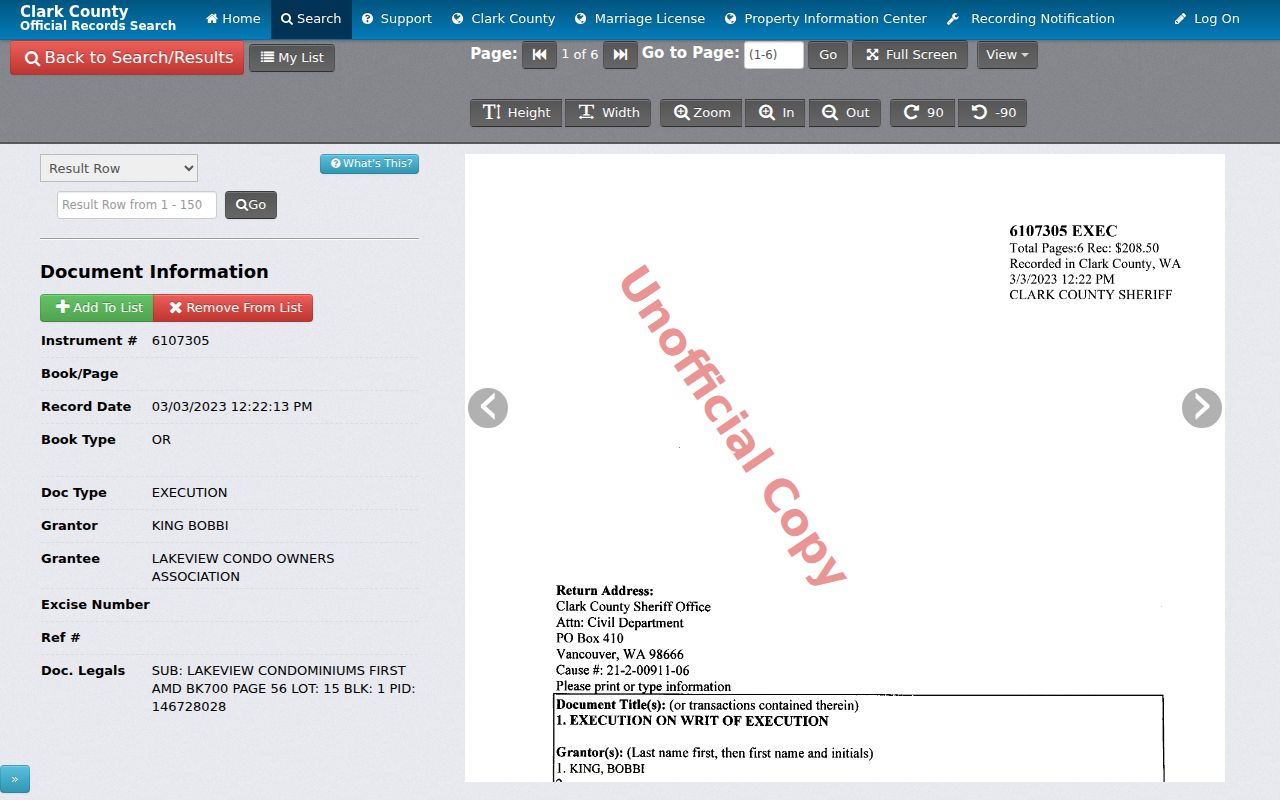
Its controls show why a surname, date range, and document type are more useful than repeatedly entering a modern address.
Camas House-History Help
Some address trails need collections that are not indexed on the web. The Clark County Historical Museum offers paid research on properties, past residents, and events. The Clark County Genealogical Society Research Library holds more than 10,000 items, including surname files, maps, microfilm, newspapers, and local burial material. Camas Public Library supplies in-library genealogy databases, NewsBank, Washington State Digital Archives, and the digitized Virginia Warren scrapbooks.
The Museum's historical research service is the documented house-history referral.
The service is especially useful when a deed yields a past name but the next directory, photograph, newspaper, or business record is unclear.
Date Camas Household Changes
A deed date marks ownership, not necessarily a move. Camas permits can show when work was requested and who appeared as owner or applicant, though an applicant may be a contractor. Obituaries and Camas Cemetery records can close a life-history gap. Probate files may name a personal representative, heirs, counsel, and estate orders, subject to redaction or sealing. NewsBank includes the Camas-Washougal Post-Record from 2010 forward and The Columbian from 1994 forward.
Use a short evidence chain: directory address, census household, newspaper life event, cemetery or probate endpoint. Each item answers a different question. Do not turn a permit applicant, obituary relative, or estate contact into an assumed occupant. For unpublished City permits or code records, use the Camas public-record index, JustFOIA, phone, mail, or an in-person request. Washington's Public Records Act requires an initial response within five business days, but an agency may need more time to locate and review files.
Camas Directories Name Past Residents
Telephone books extend the address trail through intermittent Camas holdings from 1929 to 2014. They can show continuity between city-directory years, but only for listed subscribers. Record the telephone number and exact locality label as separate facts. A Washougal listing, Vancouver volume heading, or Camas postal label can reflect publication geography rather than a household move.
Owners are only one part of the household. Camas appears within Vancouver directories for 1907-08, 1909, 1911, 1914, 1915, 1917, 1920, 1922, 1925, 1926, 1928-1932, 1934, 1936, 1940-1942, 1945-46, 1948, 1950-1956, and scattered later telephone years through 2014. Entries may list a spouse, occupation, employer, home address, phone, or owner and renter notation. They omit unlisted households and can lag a move.
Pair the nearest directory before and after each public census. Transcribe the whole household, then compare name forms, ages, work, and nearby households in the census schedule. The collections and abbreviation rules are covered on the Camas city directory page. When no address index exists, search the householder name, then browse nearby entries or use a criss-cross volume arranged by address.
- Choose one directory year on each side of the event being studied.
- Record names, spouse, work, address, phone, and any owner-renter mark exactly.
- Find the matching census year and compare the complete household and neighboring names.
- Test the result against a deed, newspaper notice, permit, cemetery entry, or probate file.
This method also handles Camas and Washougal overlap. A newspaper, court address, or telephone listing may use the neighboring city without proving a move. Keep postal locality, event place, and municipal jurisdiction in separate notes.
Lawful use. Camas previous-resident research belongs in house history, genealogy, and personal inquiry. Washington law forbids stalking, harassment, and cyber harassment.